
#Biorobotics
Equipped with sensory modalities in a technological breakthrough, who better than animals to guide us towards bio-inspired navigation systems
My research focuses on biorobotics, a discipline at the interface between life sciences and robotics.
This work focuses on animal behavior, bio-inspiration, biomimicry, and bio-inspired robotics to create precise long-term navigation systems which operate without recourse to man-made infrastructures (e.g. GPS or 5G networks). This allows us to explain perception-action coupling to understand animals’ spatial orientation mechanisms and to apply them to robotics.
Humans and animals perform similar complex navigation tasks, yet have vastly different visual systems and brains. I am focusing my research on the use of polarized light to invent the navigation systems of tomorrow.
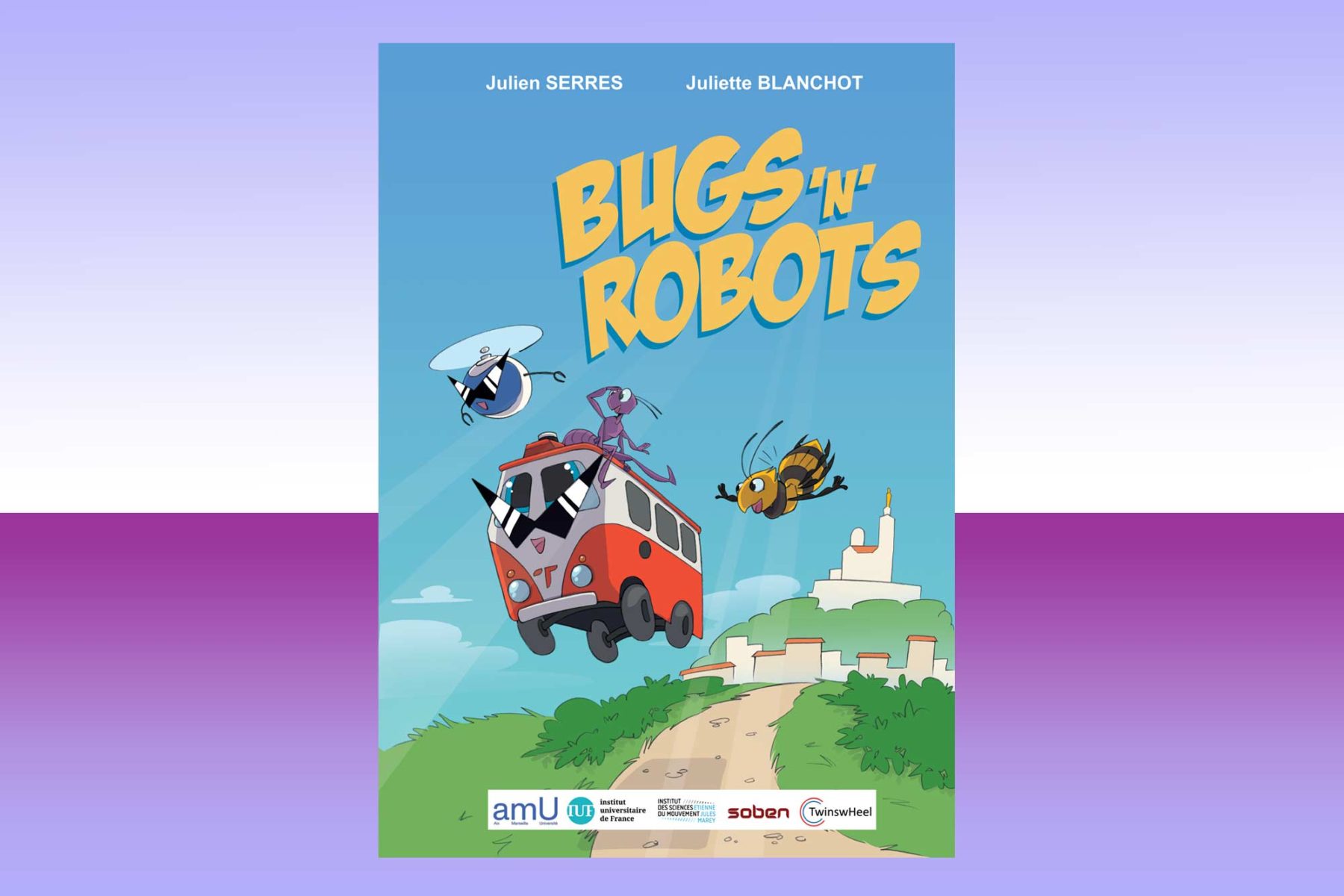
Comic strip
Title: Bugs ‘N’ Robots
Publication date: October 1st, 2025
Scenario: Julien Serres
Artwork and colors: Juliette Blanchot
License: CC-BY-NC-SA
Synopsis
It is 2035, and all satellite constellations for geolocation are operational, from the European Galileo to the American Starlink. Everything is working perfectly in this hyperconnected world of 8G and GPS, with robots going about their business in urban centers, delivering goods or conducting field surveys. Suddenly, the Starlink geolocation service goes down, along with all other satellite constellations. One by one, they stop transmitting signals due to space debris triggering a chain reaction of satellite destruction.
The mobile robots and other autonomous vehicles are lost in the moment, yet they watch the ceaseless dance of flying insects: on the ground, MiMi-Ant the ant; in flight, Honey the honeybee, which looks like an aerial racecar with an aerodynamic canopy shaped like a pair of chic, stylish sunglasses.
The robots’ artificial intelligence (AI) then summons these insects to learn from and exchange information with them, asking how they manage to survive and navigate without human satellite technology—a move that ultimately leads to a happy ending, with the ongoing missions successfully completed. The AI is surprised by the simplicity, frugality, and ingenious solutions embedded in the brains of these small creatures, which initially seemed ridiculous and insignificant to it—or merely destined to plant seeds or produce honey in the service of humanity—but are ultimately perceived as a true source of inspiration for “Green AI.”
News All news

Projects in Biorobotics

Current
research projects
Completed
research projects
Scientific and academic guardianships